
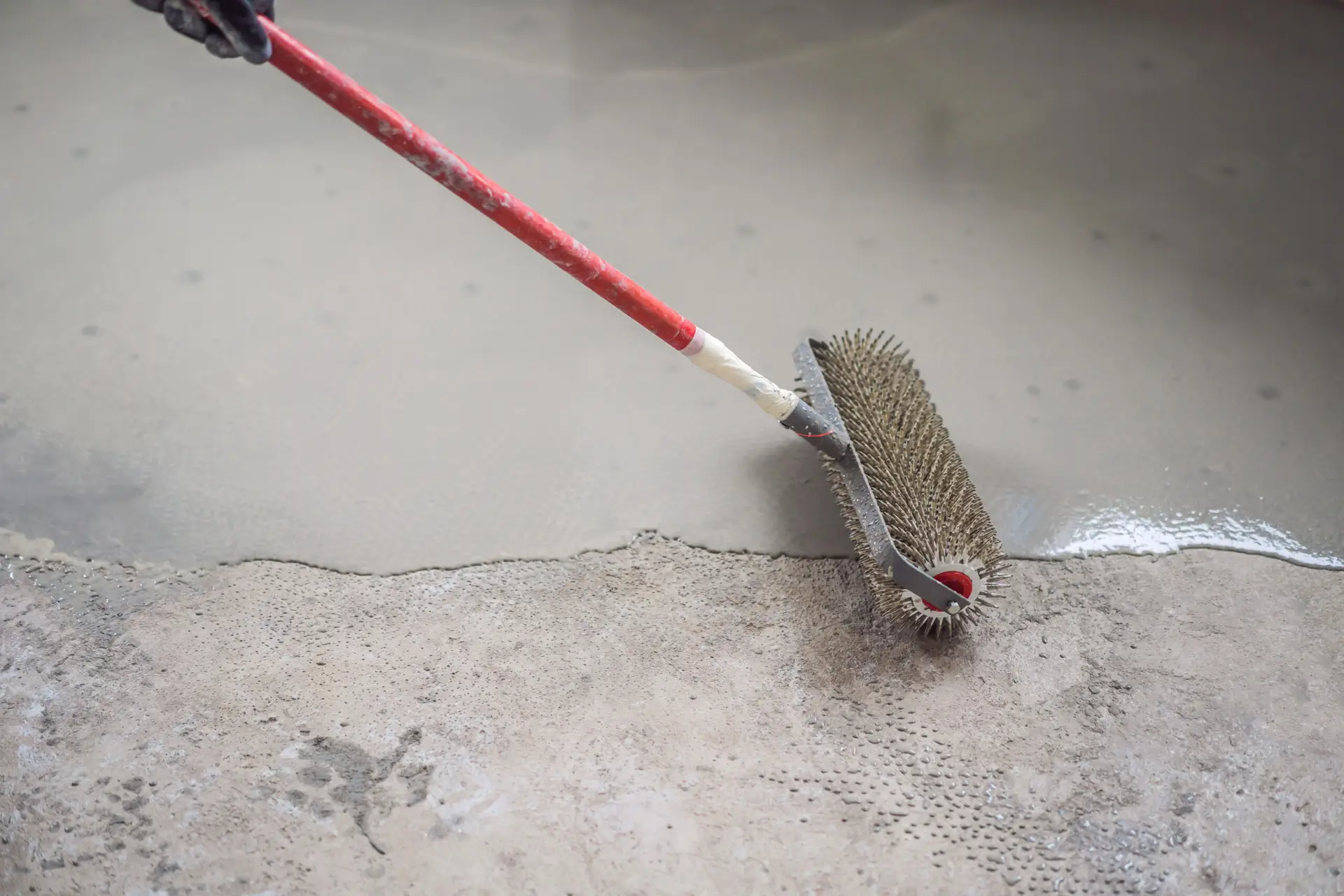
A bare concrete basement floor is prone to dusting, staining, and feeling cold and damp. Applying a proper concrete coating transforms the space by sealing the porous surface, improving cleanliness, and resisting moisture. The key to a successful basement floor paint job is a thorough moisture test and meticulous surface preparation.
Why Basement Floors Need Repainting
Unlike above-grade floors, basement concrete slabs are often in direct contact with the ground, subjecting them to unique environmental stresses.
Moisture, Traffic, and Wear Issues
- Moisture Vapor Transmission: Even a “dry” basement can experience moisture vapor rising through the concrete slab. If the wrong paint is used, this trapped moisture will cause blistering and peeling.
- Abrasion and Traffic: Basement floors often endure heavy foot traffic, tool drops, and the movement of equipment (like washers, dryers, and storage racks), requiring a coating far more durable than standard house paint.
- Concrete Dusting: Unsealed concrete releases fine dust (efflorescence) that covers everything and contributes to poor air quality.
Improves Durability and Cleanliness
A specialized concrete coating provides an impermeable barrier that offers several benefits:
- Increased Durability: Epoxy and $100\%$ acrylic concrete paints are designed to withstand vehicle traffic, chemical spills, and high abrasion.
- Easy to Clean: Sealed floors are resistant to oil, grease, and water, allowing for easy cleanup with a simple mop and detergent.
- Brightens the Space: Lighter colored paint reflects light, making the basement feel larger, brighter, and less dungeon-like.
Prepping the Floor
Preparation is paramount. If the floor is not properly prepared, even the most expensive paint will fail.
Clean Thoroughly and Repair Cracks
- Moisture Test (Crucial Step): Before starting, tape down a $2\text{ ft} \times 2\text{ ft}$ square of plastic sheeting tightly to a section of the floor for $24$ hours. If condensation forms underneath the plastic, the floor has excessive moisture vapor transmission. In this case, you must apply a specific moisture-vapor barrier primer before any coating.
- Clean: Sweep and vacuum thoroughly. Clean the floor with a concrete degreaser and etcher (often a diluted muriatic acid or citric acid solution, following manufacturer directions carefully). Etching creates the microscopic profile necessary for the paint to bond.
- Repair Cracks: Fill all cracks and divots with a $100\%$ solids epoxy filler or a specialized cement repair compound. Allow ample curing time, then sand the patches flush with the floor surface.
- Final Rinse and Dry: Rinse the floor completely to remove all cleaner and etching residue. The floor must be bone-dry before priming. Use fans and dehumidifiers to speed up this process, as residual moisture will cause adhesion failure.
Remove Old Paint or Sealant
If the existing coating is peeling, flaking, or glossy, it must be removed.
- Loose Paint: Use a floor scraper or wire brush to remove all loose or bubbled paint.
- Slick Coatings: If the existing paint is sound but slick, you will need to scuff it thoroughly with a floor buffer using an abrasive pad, or apply an aggressive concrete etcher to create surface profile. A new coating will not adhere to a glossy, smooth finish.
Choosing the Right Paint
Avoid standard house paint. You need a coating specifically engineered for concrete and sub-grade environments.
Epoxy-Based or Concrete-Specific Coatings
| Coating Type | Description | Best For |
| Two-Part Epoxy | Provides the most durable, hardest, and chemical-resistant finish. Requires mixing a resin and hardener, and must be applied within a specific working time. | Garages, workshops, and high-traffic utility basements. |
| $100\%$ Acrylic Concrete Paint | High-quality, water-based paint that is highly resistant to efflorescence and easy to apply. More breathable than epoxy. | Finished basements, living areas, or lower-traffic spaces. |
Anti-Slip and Moisture-Resistant Finishes
- Moisture Resistance: Always check that the product is rated for use on below-grade concrete and can handle mild moisture transmission.
- Anti-Slip (Mandatory): Painted floors, especially those with an epoxy or semi-gloss finish, become extremely slippery when wet. Always mix an anti-slip additive (usually fine sand or aluminum oxide grit) into the final topcoat to provide texture and traction.
Step-by-Step Painting Process
Plan your application carefully, as recoat times are strict, and you must maintain a wet edge.
1. Apply Primer and Two Coats of Paint
- Primer: Apply one coat of the recommended concrete primer. If you performed a moisture test and it failed, use the specialized vapor barrier primer here. Use a long-handled roller with a $1/2$-inch nap (or a specialty epoxy roller, if applicable).
- First Coat: Once the primer is dry (usually $4$-$8$ hours, check the can), apply the first coat of your chosen coating. Start in the corner farthest from your exit and work your way toward the door, rolling in small sections to maintain a wet edge and avoid lap marks.
- Flake Application (Optional for Epoxy): If using decorative vinyl flakes with epoxy, broadcast them lightly into the wet first coat while it’s still tacky.
2. Allow Proper Curing Time Before Walking
- Second Coat: Allow the first coat to cure according to the manufacturer’s directions (typically $12$ to $24$ hours for epoxy; less for acrylic). Apply the second coat of paint, incorporating the anti-slip additive into this final layer.
- Foot Traffic: Wait at least $24$ to $48$ hours before allowing light foot traffic.
- Heavy Traffic/Furniture: Wait a full $5$ to $7$ days for acrylics and at least $72$ hours to one week for epoxy to achieve sufficient curing before moving heavy furniture, storage racks, or vehicles onto the floor.
FAQs
Can I paint directly over old basement paint?
Only if the old paint is adhering perfectly and is not peeling or flaking anywhere. If the old coating is an oil-based paint or an unknown sealant, you must aggressively sand and profile the entire surface, or strip it entirely, to ensure chemical compatibility and proper adhesion with your new concrete-specific coating. When in doubt, strip it or hire a professional grinder to create a fresh surface profile.
How long does basement floor paint last?
- High-Quality Epoxy (Properly Prepped): $15$ to $20$ years under normal residential use.
- $100\%$ Acrylic Concrete Paint: $5$ to $10$ years before a recoat is typically needed due to wear or color fading.
The lifespan is overwhelmingly determined by the quality of the initial cleaning, crack repair, and moisture mitigation. A floor that fails in the first year usually does so because of poor preparation, not poor paint quality.