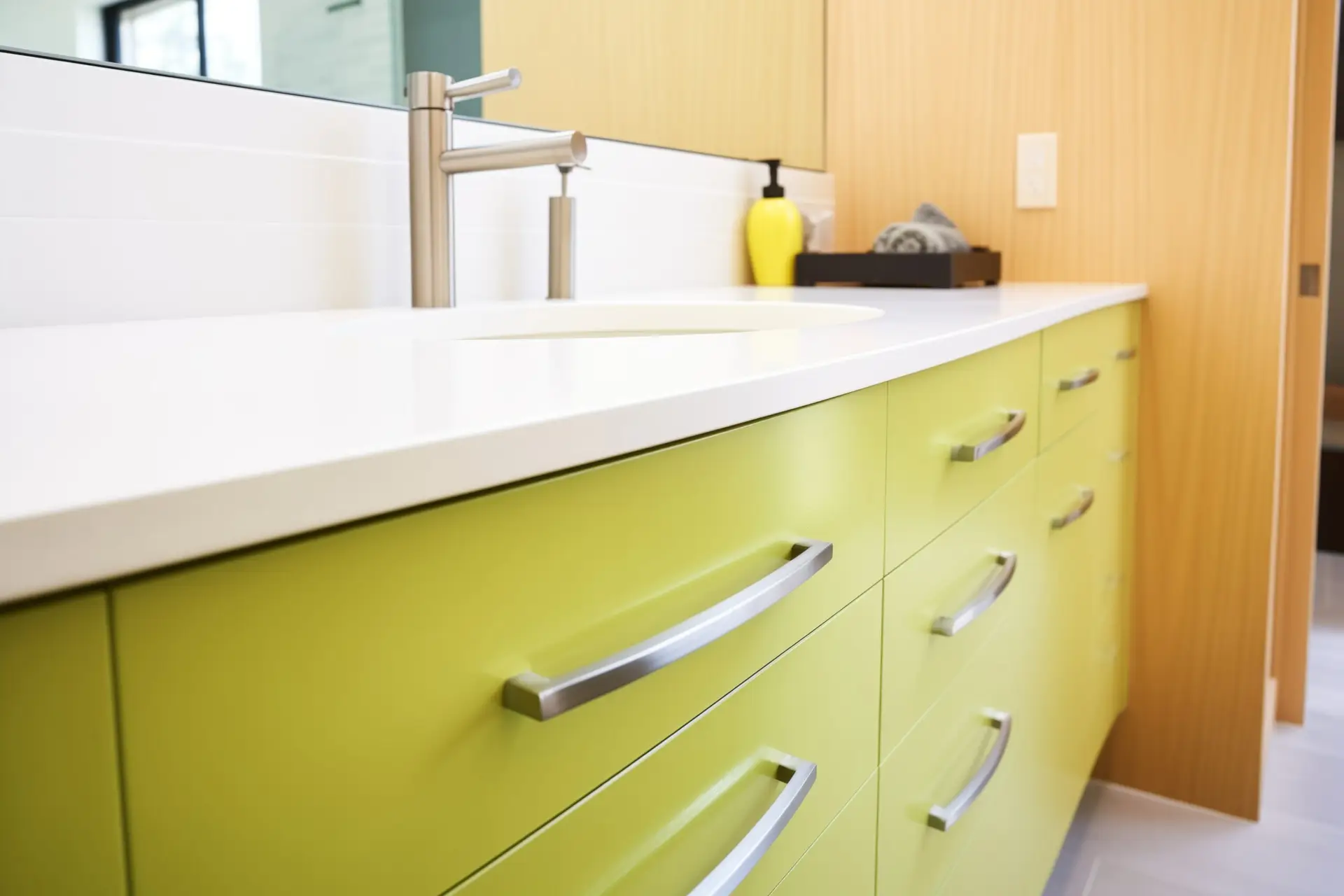
Painting non-wood bathroom cabinets—including those made of MDF, laminate, or thermofoil—is a challenging but highly rewarding DIY project. The success of the paint job depends entirely on selecting the right primer and ensuring perfect surface preparation to overcome the inherent slipperiness and non-porosity of these engineered materials.
Common Non-Wood Cabinet Materials
In modern American homes, non-wood cabinets are popular due to their cost-effectiveness and uniformity. Each material presents a unique challenge for paint adhesion.
MDF Cabinets
Medium-Density Fiberboard (MDF) is made by breaking down hardwood and softwood residuals into fine fibers, combining them with wax and resin, and forming panels under high pressure and temperature.
- Pros: It is perfectly smooth, resists warping better than solid wood in humidity, and is typically cheaper.
- Painting Challenge: While the flat surfaces are ideal for painting, the cut edges (where doors or boxes meet) are extremely porous and will soak up paint and primer like a sponge, leading to a rough, uneven texture and potential swelling if exposed to too much moisture before sealing.
Laminate and Thermofoil Cabinets
These two materials share a similar slick, non-porous surface that actively resists paint adhesion.
- Laminate: This consists of a decorative paper layer (often mimicking wood grain or solid color) fused with plastic resins, bonded to a core (usually particleboard or MDF). It is extremely hard and smooth.
- Thermofoil (Rigid Thermal Foil): This is a vinyl material molded under heat and pressure to the shape of an MDF door. It provides a seamless finish and is particularly common in builder-grade or older stock cabinetry. Thermofoil is less durable than high-pressure laminate and is prone to peeling and bubbling when exposed to excessive heat (e.g., from small appliances) or steam.
Material-Specific Prep Requirements
For non-wood materials, preparation is always a two-step process: chemical degreasing followed by chemical or mechanical roughening.
Cleaning and Degreasing Non-Wood Surfaces
This step is the most critical. Any residue (soap scum, hairspray, grease, skin oils) will prevent the bonding primer from adhering, causing the paint to peel off in sheets later.
- Use a Strong Degreaser: Use Tri-Sodium Phosphate (TSP) substitute or a heavy-duty household degreaser. For bath cabinets, focus on areas around handles and knobs where oils accumulate.
- Rinse Thoroughly: Use a sponge dampened with clean water to wipe down all surfaces.
- Dry Completely: Allow the cabinets to air dry completely before proceeding to the next step.
Sanding vs. Deglossing
The method you use to create surface “tooth” depends on the material:
| Material | Recommended Method | Grit Size | Purpose |
| MDF | Light Sanding & Edge Sealing | 220-grit | Lightly scuff the smooth surface. Use wood filler or spackle on the porous edges, let it dry, and sand smooth to prevent swelling. |
| Laminate | Deglossing & Scuff Sanding | 220-grit or higher | Apply a chemical deglosser (“liquid sandpaper”). Follow up with a very light scuff sand to break the surface tension, but avoid creating deep scratches. |
| Thermofoil | Chemical Deglossing Only | N/A | Do not aggressively sand. Thermofoil is very thin plastic film. Aggressive sanding can melt or tear it. Rely heavily on a chemical deglosser and a bonding primer. If the thermofoil is already peeling, it must be removed or glued down before priming. |
Choosing the Right Bonding Primer
Because non-wood surfaces are non-porous, a standard latex or wood primer will not bond reliably. A bonding primer is mandatory.
- Shellac-Based Primers (e.g., B-I-N): These offer maximum adhesion on the slickest surfaces like glass, metal, and plastic. They seal the surface fully and dry quickly. A note on MDF: Shellac primers are fast-drying and thin, making them excellent for quickly sealing porous MDF edges without causing swelling.
- High-Adhesion Acrylic Primers (e.g., Zinsser Bulls Eye 1-2-3, Stix): These water-based options provide a strong bond with lower volatile organic compounds (VOCs) and easier cleanup, making them a more pleasant choice for indoor use, provided the surface is perfectly clean.
Best Paints for Non-Wood Bathroom Cabinets
Choosing the right topcoat is vital for resisting the constant humidity cycles typical of a bathroom.
Cabinet-Grade Enamels
The best choice for durability and a smooth finish is a high-quality acrylic-urethane enamel designed for cabinetry. These products combine the easy cleanup of water-based paint with the hardness and adhesion of traditional oil-based coatings.
- Popular Options (U.S.): Benjamin Moore Advance, Sherwin-Williams Emerald Urethane Trim Enamel.
- Finish: A Semi-Gloss or Satin finish is highly recommended. Glossier finishes are smoother, making them inherently less likely to hold moisture, easier to clean, and more resistant to scuffing and fingerprints.
Moisture-Resistant Paint Systems
The entire system—primer and topcoat—must be moisture-resistant.
- Sealing is Key: The bonding primer must completely seal all surfaces, especially the edges of MDF, to prevent steam and humidity from penetrating the core.
- Hard, Non-Porous Topcoat: The cabinet enamel provides the final, hard shell that prevents water from contacting the primer or the substrate. Ensure the topcoat is applied in 2-3 thin, even coats for maximum durability.
Application Tips for Bathrooms
Humidity and poor ventilation are the biggest enemies of freshly applied paint.
Proper Ventilation During Painting
Paint fumes, especially from shellac-based or oil-based primers, can be overwhelming and hazardous in a small, enclosed space like a bathroom.
- Continuous Airflow: Always open a window and use an exhaust fan to draw fumes out.
- Fresh Air Intake: If possible, draw fresh air into the room through another window or door to aid the drying process and improve safety.
- Respiratory Protection: When using solvent-based primers, wear a certified respirator with organic vapor cartridges.
Drying and Curing Times Before Use
It is crucial to understand the difference between dry time and curing time:
- Dry Time (Touch-Dry): The time until the surface is dry to the touch, usually a few hours. This is when you can apply the next coat.
- Curing Time (Full Hardness): The time until the paint achieves its maximum chemical hardness, usually 7 to 30 days for high-quality enamels.
Critical Bathroom Rule: Do not use the shower in the bathroom for at least 7 days after the final coat of paint. Steam and high humidity during the curing process will soften the paint film, making it highly vulnerable to sticking (blocking) and damage. If you must use the shower, run a dehumidifier and fans continuously.
FAQs
Can thermofoil cabinets be painted?
Yes, but only if the thermofoil is fully intact and not peeling. If it is already peeling, the best course of action is to carefully peel off all the loose vinyl, clean the exposed MDF core, and then treat the MDF like raw wood (sealing the edges and using a strong bonding primer) before painting. Painting over peeling thermofoil will result in immediate failure.
Will paint peel in a humid bathroom?
Paint will only peel in a humid bathroom if the preparation or product selection was faulty. If the surface was not properly cleaned and degreased, or if a bonding primer designed for slick surfaces was skipped, the paint will fail. When correctly prepped and sealed with cabinet-grade enamel, the paint system will handle humidity without peeling.
How long do painted non-wood cabinets last?
When a non-wood cabinet is properly prepped and finished with a high-quality cabinet enamel, the paint job can easily last 5 to 10 years or more with routine cleaning. The limiting factor is usually the underlying material’s physical durability (e.g., deep scratches in MDF) rather than the paint’s ability to adhere.
Call to Action
Don’t let the thought of paint peeling deter you from modernizing your bathroom. Achieving a flawless, durable finish on tricky surfaces like laminate and thermofoil is possible, but it requires professional products and meticulous application techniques.
Ready to transform your bathroom? Contact Mass Pro Painting today for a detailed consultation and to guarantee a humidity-proof cabinet finish!